
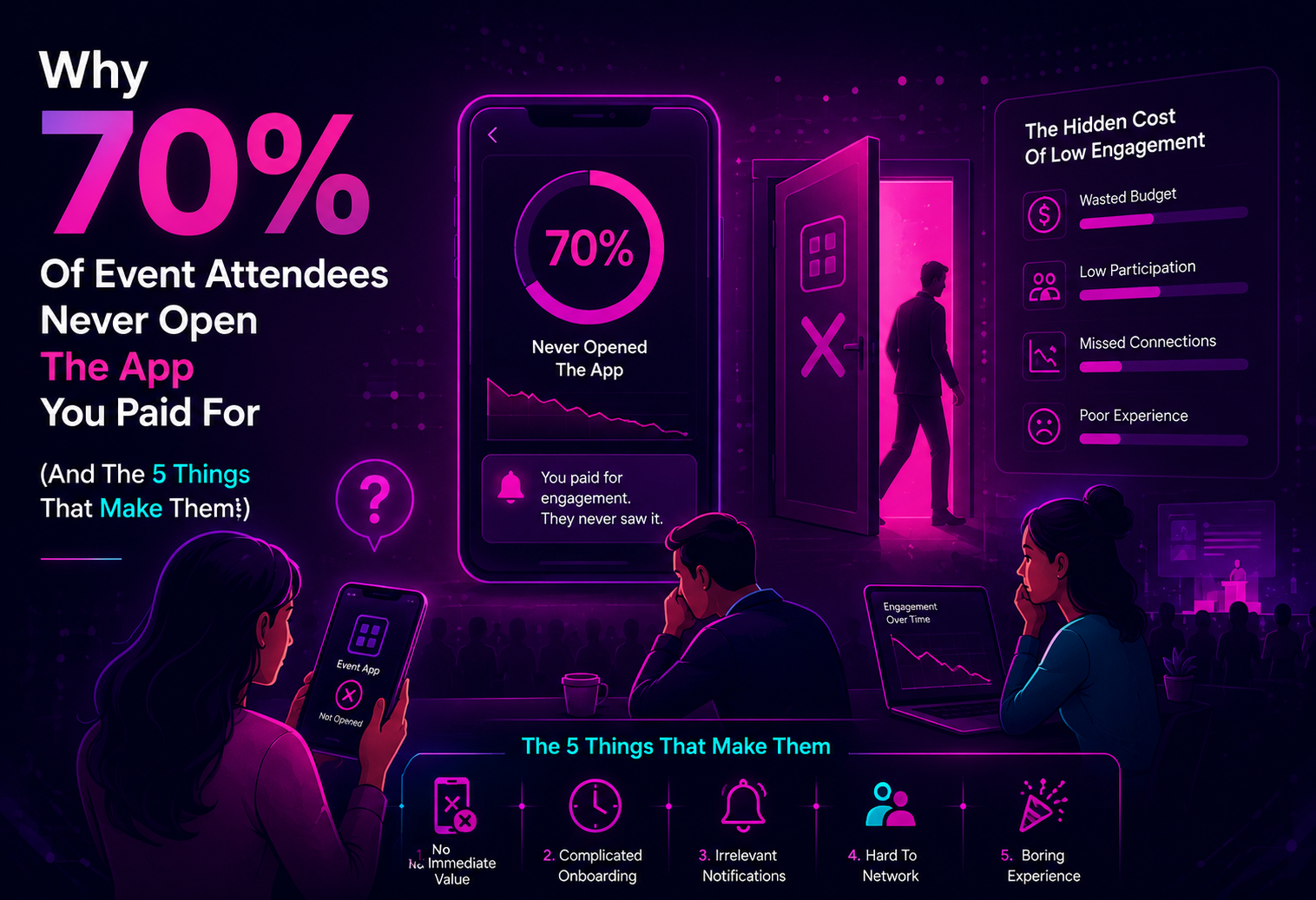
Event organisers invest significant time and budget into creating memorable experiences. Event apps have become an increasingly common part of that process, providing attendees with access to schedules, speaker information, networking opportunities, event updates, maps, and interactive features. Modern event apps are designed to help attendees manage their event experience while providing organisers with valuable engagement opportunities and event data.
Yet many organisers face a frustrating reality.
Simply launching an event app does not guarantee that attendees will use it. Even when an app contains valuable information and useful functionality, many attendees either never download it or fail to engage with it after installation.
The challenge is not simply getting people to install an app. The real challenge is giving them a reason to keep returning to it throughout the event journey.
At Expo Social, we believe successful event technology should enhance the attendee experience rather than become another unused digital tool. Understanding what drives engagement is often the difference between an app that gets ignored and one that becomes an essential part of the event.
Why Event Apps Sometimes Fail To Gain Traction
Many event apps are launched with good intentions but limited attendee-focused thinking.
Organisers often concentrate on what information they want to provide rather than what attendees actually want to access. If users do not immediately see value when they open the app, there is little incentive to return.
Attendees already receive large amounts of information through emails, websites, social media, and messaging platforms. If an event app simply duplicates information available elsewhere, many people will not see a compelling reason to engage.
Successful event apps provide functionality that genuinely improves the attendee experience rather than simply acting as a digital programme.
The Importance Of Creating Immediate Value
The first few minutes after an attendee downloads an event app are critical.
Users quickly decide whether an app is worth their attention. If they immediately find useful information, relevant content, or personalised features, they are far more likely to continue using it throughout the event.
Conference and event apps are most effective when they help attendees manage their schedules, access event information quickly, and interact with the event in meaningful ways.
This is why engagement strategies should begin before the event itself.
1. Personalised Agendas And Schedules
One of the most effective ways to encourage app usage is through personalised event schedules.
Attendees want to know where they need to be, when sessions begin, and how to manage their time effectively. When users can create their own personalised agenda within the app, it becomes a practical tool rather than simply an information source.
Conference apps commonly allow attendees to build customised schedules, helping them organise their event experience more efficiently.
The more useful the app becomes for daily planning, the more frequently attendees are likely to return to it.
2. Real-Time Notifications And Updates
Events are dynamic environments.
Schedules change, speakers are updated, rooms move, and announcements need to be communicated quickly. One of the key advantages of an event app is the ability to provide real-time updates directly to attendees.
Conference apps frequently include push notifications and live updates to keep users informed about important changes and event developments.
When attendees know the app is the primary source for important information, they are far more likely to open it regularly throughout the event.
3. Networking Opportunities
Networking remains one of the main reasons many people attend events.
Whether attending conferences, exhibitions, trade shows, or corporate events, delegates often hope to make valuable professional connections. Event apps that facilitate networking can therefore become significantly more valuable to attendees.
Many event platforms now include messaging features, attendee directories, profile matching, and networking tools that help users connect with one another. Event management platforms frequently incorporate messaging and digital networking capabilities to encourage attendee interaction.
When an app helps attendees achieve one of their core event objectives, engagement naturally increases.
4. Interactive Experiences
Passive information consumption rarely drives long-term engagement.
Interactive features encourage attendees to actively participate rather than simply observe. Polls, Q&A sessions, surveys, feedback tools, and other engagement mechanisms can help create a more immersive experience.
Many event apps incorporate live polling, audience questions, surveys, and interactive participation features specifically designed to increase attendee engagement.
These features help transform the app from a static information source into a live event companion.
5. Gamification And Incentives
One of the most powerful ways to increase engagement is by making participation rewarding.
Gamification uses challenges, points, achievements, leaderboards, and rewards to encourage users to complete desired actions. The concept has been widely adopted across digital platforms because it encourages repeated engagement and creates a sense of progression. Gamification technologies are specifically designed to increase participation and engagement by applying game mechanics to user behaviour.
Within event environments, gamification can encourage attendees to visit exhibitors, attend sessions, complete surveys, network with other delegates, and explore more of the event.
Many event management platforms now include gamification features as part of their attendee engagement strategy.
Engagement Starts Before The Event
One common mistake is treating the event app as something attendees should start using only after arrival.
In reality, engagement should begin well before the event opens. Early access to schedules, speaker information, networking opportunities, exhibitor details, and event content gives attendees reasons to download and explore the app in advance.
This early engagement helps establish habits that often continue throughout the event itself.
The more integrated the app becomes within the attendee journey, the greater the likelihood of sustained usage.
User Experience Matters
Even the most feature-rich event app will struggle if it is difficult to use.
Attendees expect digital experiences to be intuitive, fast, and easy to navigate. If users cannot quickly find what they need, they may abandon the app altogether.
Successful event technology focuses not only on functionality but also on usability. Every feature should contribute to a smoother attendee experience rather than creating additional complexity.
Measuring Success Beyond Downloads
Downloads alone do not tell the whole story.
An app may achieve impressive installation numbers while generating very little meaningful engagement. Event organisers should also consider metrics such as active users, session frequency, feature utilisation, networking activity, survey participation, and content engagement.
These measurements provide a more accurate picture of whether attendees are genuinely using the platform throughout the event.
Ultimately, the goal is not simply to have attendees download the app. The goal is to make the app an essential part of their event experience.
How Expo Social Can Help
At Expo Social, we understand that event technology must deliver genuine value to attendees if it is going to achieve meaningful engagement. Successful event apps do more than provide information. They support networking, encourage participation, deliver real-time updates, and help attendees maximise their event experience.
By focusing on the features that attendees actually want to use, organisers can create digital experiences that support stronger engagement before, during, and after an event.
Conclusion
Many event apps struggle because they focus on delivering information rather than creating value.
Attendees are far more likely to engage when an app helps them manage their schedules, stay informed, connect with other attendees, participate in interactive experiences, and earn rewards through gamification.
The most successful event apps become an integral part of the attendee journey rather than simply a digital version of the event guide.
By focusing on personalised agendas, real-time updates, networking, interactivity, and gamification, event organisers can significantly improve engagement and ensure their event app becomes a tool that attendees genuinely want to use.
Leave a Reply